On openness, control, and what happens when the tools you trust stop working
I sit and ponder this strange, strange life — one where things are uncertain, and we can’t see more than two steps ahead.
We can’t determine whether what is unfolding in our lives is good or bad. But having faith that it’s all for the good feels far more freeing than believing things are simply happening to us.
It’s always better to be open to experience than to judge it and determine that it’s here to hurt us.
Being open to our lives is not something we were taught, although we came into this world with this innate quality.
Just recall the last baby you saw — how they reach for everything with curiosity, touch unfamiliar objects without hesitation, and look at new faces without labeling them as safe or unsafe, good or bad.
Counter to our true nature, we were taught good and bad. We were taught to fear what we learned was bad and to hold tightly to what was ours and what we learned to be good. A child is taught that being “good” is doing what his or her parents want, and “bad” is disobeying or behaving in ways the parents deem inappropriate.
This puts us in quite a predicament, especially since we live in an ever-changing world full of different cultures, personalities, and experiences. A slight shift in perspective can change what was once good into bad, and vice versa. And I’m not talking about violence, which is almost always harmful — unless you are protecting yourself. So even with violence… context matters.
Take something less extreme, such as quitting a stable job. From one perspective, it may seem irresponsible, reckless, even foolish. From another, it may be courageous, aligned, and necessary for growth. Notice how a shift in perspective reshapes the judgment we impose on it.
This openness — meeting experience without judgment, without expectation — feels like the closest thing to liberation. It reminds me of a definition of mindfulness I’ve always returned to: paying attention, on purpose, in the present moment, without judgment. That last part is the whole thing.
What if life is simply unfolding, and we have far less control than we think? What if our willpower was never meant to be used to rearrange the world, but rather to meet it?
We try to manipulate situations, outcomes, even people — to align with what we believe is good for us. Getting what we want becomes the definition of good. Not getting it becomes bad. But we don’t really know that. We don’t know if what we desire is truly right for us. And even when we do get it, we may later label it a mistake, a disappointment, something that went wrong.
But did it? Or did it simply show us something we couldn’t have seen otherwise? Because when we don’t learn from an experience, we repeat it — the same patterns, the same cycles, quietly returning in different forms.
So perhaps our willpower isn’t in controlling what unfolds, but in how we respond to it. In what we are willing to see. In what we are willing to learn. And in how we carry that understanding into the next moment that arrives.
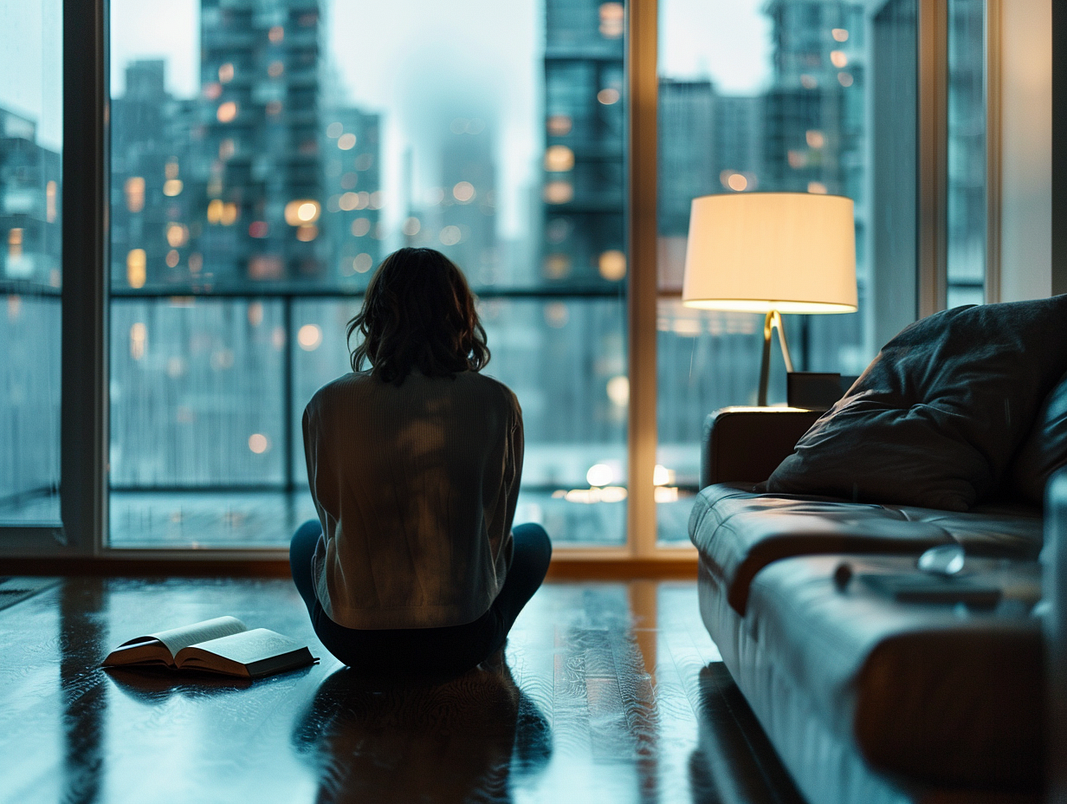
Recently, I have come to a point where I don’t know which way to go, where to turn, or how things will unfold. I feel fearful, and my energy is low. Even as I write this, my eyes are closing. I can’t keep afloat. It feels like I’m drowning.
It was in this place that I found myself inside what St. John of the Cross called ‘the dark night of the soul.’ I don’t use the term loosely. It isn’t simply sadness, or a hard season, or feeling lost in the ordinary sense. It is something quieter and stranger than that — a deeper disorientation, where the familiar signposts vanish, where the path goes dark, and where the tools you’ve always used to make sense of things no longer seem to work. You don’t know who you are. You don’t know where you’re going. And there is no map.
Everything I wrote above — the openness, the releasing of control, the willingness to meet life as it is — I believed before this season arrived. But believing something and being asked to live it are two different things. The dark night was not the source of these ideas; it was the test of them.
There is always something that can drop you into the lows — because, surprise, surprise, it is part of the journey. Like light and dark, it always exists.
I often feel like it’s a roller coaster. One moment you’re up, the next you’re down. But in life, it’s not just a split second of either. Happiness, at its peak, often feels fleeting. Sadness, even at a lower intensity, tends to linger longer than we expect — or would like.
I sometimes wonder whether what we focus on truly expands — whether the power of our attention is what keeps us anchored in a particular mood. I’ve noticed it in small ways: a difficult morning that brightens when I step outside, a spiral of worry that quiets when I pick up a book. Without the low, we wouldn’t recognize the high.
And in our darkest moments, the light finds its way through the cracks — not despite the darkness, but because of it. The contrast is what makes it visible.
There is often a moment of clarity — a quiet shift where we can step outside the despair, if only briefly. And in that space, something loosens. Something releases.
And for a moment, we are no longer caught in the cycle.
That is where we can begin again.
If this resonated — the uncertainty, the not knowing, the tools that suddenly stop working — I made something for exactly this moment.
Clarity Without Force is a short guided audio series for when your mind is spinning and thinking harder isn’t helping. The first session is free. Free sample
Follow me on Medium for more recent writing.